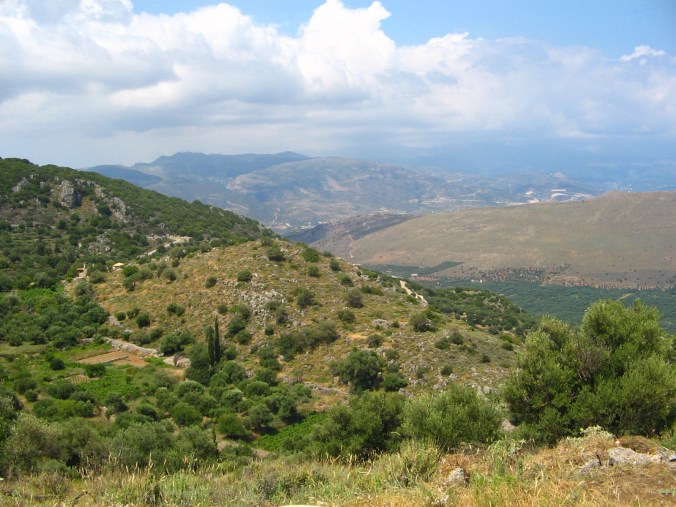
 Cornwall was difficult for another reason, beyond my fear of impending bird flu: I was heart-broken. I had just come out of the most beautiful several months of my life thus far: first, I got to work on two projects in Bermuda with my professor and friends. But second, and most of all, I spent the summer on a field school on the island of Crete, and fell in love for the first time in my life.
I was always kind of late bloomer when it came to dating. I had never had a significant other throughout high school and undergrad, and had been on very few dates. So much held me back – insecurity, self-hate, fear – I’m sure many can relate. I never felt comfortable in my own skin. I worried what other people would say about the person I was dating (especially my family), as if my self-worth was somehow reflected in my significant other. I was shy. I seemed mostly in to people I couldn’t have. I could go on.
So on this field school, on my first night, I met someone. He came and sat with my friends and I at dinner. He bought me raki (Cretan moonshine) later in the night. I assumed he had a girlfriend. Throughout that first week he would talk to me, but I thought little of it. The second weekend, after our first full week of work, I was looking forward to seeing him. And when there was a moment when he was sitting alone at the local bar where we all hung out, I asked if I could come sit with him. We talked and talked and talked and I relished in every second of it. And it was clear to us and to everyone else that we were a thing.
And it was a fantastic summer! One of those summers where the stars seemed to align and we all just had fun. And I was in love. On Crete. Now, if there is one lesson in this experience (which I failed to learn), it’s that things happen at their own pace. I wanted so desperately to have someone throughout my adolescence and thought that there was something fundamentally wrong with me because I couldn’t find someone. I watched my friends find people and fall in (and out of) love. I watched them go on dates. And I railed against the fact that I could not do this. But I did – it happened in its own time. And I would not have changed a thing about it, the fact that I had my first experience with love during a summer on the island of Crete. Thank you, Universe. I’ll take that!
Now, I mentioned at the start of this post that I was heartbroken in Cornwall, the town where I went to work at my government job after Crete. This summer love, like many summer loves, was only destined for a season. He went off to start doctoral work at a very prestigious school in a very lovely location. And I went off to my government job in the mill town. I had some problems with this :). If you’ve read any earlier posts, you might notice I’m a tad hard on myself. And I did not take this outcome well. In fact, I used it to paint the picture of me that I had always painted of myself: I was the loser of the story, destined to play the sad character of the tale, the fool, the pitiful one, etc. etc.
Eeyore sounds like a good name for me here – where on earth did I come up with this tale? I have no idea. It stays with me to this day – that I will fall from grace and be the ultimate loser of the story. That’s what played out here, and this arrangement, him and me, just seemed to confirm this for me.
And I missed him – so terribly. I tried keeping in touch, but he eventually drifted away into his new life. We hadn’t made any plans to stay together – it seemed unrealistic, even though he had once shyly suggested there was an apartment waiting for me should I choose to come. But I could not leave the job I had lined up – that was not allowed in my mind. And plus, 100%, it would NOT have worked out. I can say this with 10+ years hindsight. Although I was full of bitter regret (and it is a bitter thing) at that time.
Most of all, though, I missed the antidote. The antidote to the pain I carried around inside of me – that feeling that I was a loser, that I didn’t measure up, that I was not ever going to be good enough. I was destined to fail – it was only a matter of time. And in wake of failure would come the bleakest abandonment a human could experience. That was my template, and love was an antidote to that. It was the drug I didn’t even realize I needed until it was being so lovingly, freely, and readily pumped into my veins that summer. More more more. I needed more. And then it was cut off, and I felt like I couldn’t breathe at times, the tightness in my chest was so all-consuming. Sick fear washed over me and clouded my world. I know this feeling all too well – it is not merely love-sickness, although love-sickness is a potent example of this feeling, an expression of this pain. It’s the emptiness of utter self-hate that is begging to be diffused with love and compassion that I haven’t learned yet to give myself. And so I look outward, for grades, accolades, attention. I know this pattern all too well – it’s one of the great and terrible themes of my life.
I’ll have much more to say about it soon.
In the meantime, here is a poem I spontaneously wrote after seeing an exhibit on Chinese art at the Royal Ontario Museum. What does this have to do with the above? Well, I was with my parents at the time, just back from Crete, reeling in the aftermath of my withdrawal. As I wondered the exhibit with my parents, my dad asked me about the boy I had met on Crete (you see, they met him, because they came and visited me on my field school) – did I keep in touch with him? Ouch ouch ouch. Why did you have to ask that? Anyways, a caption from the museum exhibit, something about playing a game with immortals, captured my attention around that same time, and I wrote a poem. Writing was my lifeline, then and now. It was what sustained me. And so this poem was just one example of what was really keeping me going then (and now):
I Dreamt of You
I dreamt of you, far along the shallow seas
You were a ghost and you whispered my name
As you drifted forth.
I dreamt of you as a child with a kite,
Running forever and ever over those hills
Until you too were soaring.
I dreamt of you in paradise, with the immortals
Playing that wonderful game.
Whenever I dreamed, you were there
And your spirit was free.
 I lived with a wonderful family in Cornwall in their charming century home. I was a boarder, and although I craved my alone space, being part of a family was a lifeline for me. I was reeling from lost love, self-hate, and being thrown into the open, no longer with any anchor (i.e. school). I felt so utterly lost and confused, and so I started to grasp on to futures, stories, trajectories – anything that would get me away from. . . me. This family believed in me, and it was because of them that I avoided descending permanently into isolated despair as I desperately tried to feel better.
 In Cornwall, I wrote and wandered a lot. That is what I love to do. I think I am closest to my true self when I do this. And while I was so often wrenched away from myself through the throes of anxiety and self-hate, fear and self-doubt, I was also glimpsing aspects of my deepest self. I used writing as my lifeline back to me. It was sometimes the only thing that sustained me in dark times.
 Muse of Tragedy